

Sometimes I have absolutely nothing to write about on TRB. I still find a way, but there are times when my queue is simply empty.
Then other times, I have so much to say that my queue contains topics that need to be explored for fear of them growing stale!
In fact, most two-part blog stories start with the intention being one, but after you hit a certain length, that alarm bell goes off that says, “Hey, this feels like a ‘Part II’ is going to be needed.”
Then there are the times where we explore an important topic and merely touch on a secondary or related topic therein, but where that second topic necessitates a blog post of its own.
Last Thursday’s blog was exactly that.
On Thursday, we looked at the “Mortgage Renewal Cliff” and traced back the origin of the term, exactly why it came to exist, and got up to speed on whether or not it’s still relevant in March of 2025.
But at the very end of the post, I mentioned mortgage delinquencies.
This was an afterthought as far as the blog was concerned, but when I ran into a client on the weekend, she said, “I read your blog on Thursday; you’ve never talked about mortgage delinquencies before, it was cool. But what is a delinquency?”
Good question.
Up until now, we’ve merely assumed that everybody knows!
My client continued to ask, “Is a delinquency the same thing as a default? And what’s it called when the bank actually takes your house and sells it?”
All good questions, but then came the kicker:
“At what point does a delinquincy rate signal a problem?”
I touched on this during Thursday’s blog, but I think that every reader, economist, lender, and banker are going to have their own answer to this question.
This is also where my favourite saying comes into play: you can make numbers say anything you want.
We’ve played this game many times before on TRB, but let me ask a hypothetical question:
If you heard that a local baseball team increased their attendance by 1000%, how would you describe that figure?
Would you describe this as “a lot”?
Relatively, yes. But relative to what?
Alright, here’s what I’m really asking: if you heard that a local baseball team increased their attendance by 1000%, would you simply assume this means many people attend the games?
Because if the team was averaging one fan per game, and another ten joined on average thereafter, then there’s your 1000% increase.
In the end, eleven fans isn’t a lot.
I talk quite a bit about relative versus absolute when I analyze statistics here on TRB, and when it comes to mortgage delinquencies, I’ve felt this really hits home.
First, a couple of definitions.
A “delinquent” mortgage is one where the borrowers are more than three months, or ninety days, overdue for payment. This is referred to as “a mortgage delinquency” as well as “mortgage in arrears.”
You’ll hear these terms used interchangeably but “delinquent” is the same as “in arrears.”
Now what is a mortgage “in default?”
That’s trickier, especially because the media will often use the terms interchangeably.
Here’s an example:
The headline says “defaults” but the article uses the word “delinquent.”
Again, you can ask ten people in the mortgage industry to differentiate between the terms, and you’ll get ten slightly different answers.
Simply put, “delinquent” means overdue. To be in “default” means to break the loan covenant, but we all know that missing a payment is exactly that. So to be “delinquent” essentially means to be in “default,” but it’s widely understood that to be in default means to continuously miss payments to the point where the lender is, or has taken action to recover the money owed, including foreclosure.
The verbiage will differ depending on the geography, and just as Americans will refer to a deposit “in escrow” and we say the funds are “in trust,” we see these terms and their definitions vary consistently.
In Canada, we use the term “mortgage delinquincy” and we define this as a mortgage where payments are overdue by 90 days.
Defaults, foreclosures, power of sales, bank sales – this is a whole other conversation. Not every delinquent borrower has their house foreclosed on by the lender and sold against their will.
Now, back to this idea that “you can make numbers say anything you want.”
Let’s look at some of the recent headlines about mortgage delinquincies.
Here’s a banger:
“Ontario’s Mortgage Delinquincy Rate Nearly Doubled In The Final Months Of 2024”
CTV News
February 25th, 2025
Hard to ignore the word “double,” right?
And there’s no fudging the numbers here. This is a 90.2% increase from Q4 of 2023 to Q4 of 2024.
But we’ll come back to this.
Three days later, we see this article in our news feeds:
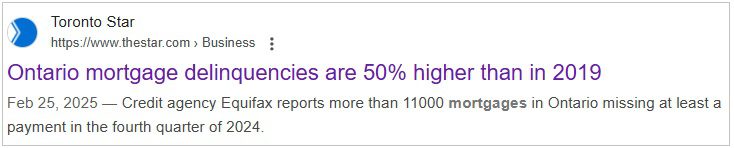
But when we click on the link, it takes us to this article:
“Ontario Mortgage Delinquincy Rate Jumps 50% Amid Growing Signs Of High-Rate Renewal Shock”
Toronto Star
February 28th, 2025
The first link said, “since 2019.”
But maybe that’s not sexy enough?
The second headline simply says “jumps 50%” and then adds “shock.”
Newspapers re-write headlines all the time, just as they update articles that have already been released. This felt like a case of trying to make the situation sound a lot more dire!
Not only that, the sub-headline reads:
“Credit agency Equifax reports more than 11,000 mortgages in the province missing at least a payment in the fourth quarter of 2024, nearly three times the number seen in 2022.”
So now we’re talking about missing one payment instead of being delinquent, which is missing three payments, and we’re also “three times,” or 300%, over 2022.
Got it.
So through two articles with three headlines, we’re looking at mortgage delinquencies:
-in Ontario
-in Canada
-year-over-year
-since 2019
-since 2022
-in Q4
-one month in arrears
-three months in arrears
Did I miss anything?
There are so many ways to make an argument when you’re armed with data.
…
Right, because this is in Ontario, but the first headline referred to delinquincy rates in Canada.
And then sometimes, we’re not given any statistic or takeaway in the headline. We’re just given this:
“Lower Interest Rates, Higher Defaults: What’s Going On?”
CBC News
March 5th, 2025
They’re not wrong.
Interest rates are dropping and mortgage delinquencies are increasing.
But mortgage delinquencies have always been viewed as a “lagging indicator” since the problem began at least three months ago.
On Thursday, I provided you with the following chart for discussion purposes:
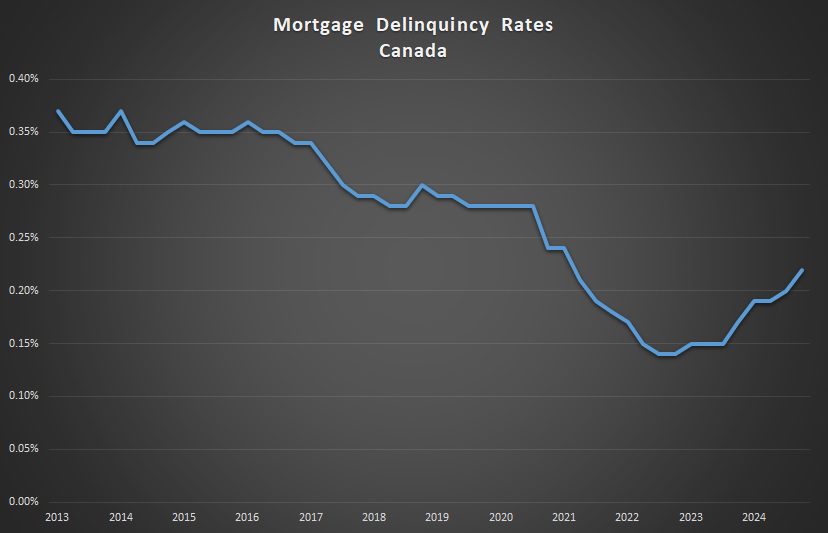
If you’re interested in the data, the CMHC publishes it HERE.
As we noted last week, the delinquency rate in Canada hit a low of 0.14% in Q3 and Q4 of 2023.
To see the same rate increase to 0.22% by Q4 of 2024 is to say that it “increased by 57.1%.”
That’s a big increase!
And while the newspapers are choosing their own statistics, whether Canada-wide, Ontario-wide, or comparing a particular quarter, month, or year to any one period in the past, I’m simply looking at the obvious data in front of me.
The mortgage delinquency rate was at a low of 0.14% in 2023.
The fact that it’s risen to 0.22% as of Q4 last year doesn’t move the needle for me at all.
What would move the needle?
Well, if that figure increases to 0.35% or thereabouts, I would conclude that the increase is troubling.
However, with the delinquency rate sitting consistently around 0.35% from 2013 through 2016, I also wonder whether this actually would be anything to write home about.
After all, do you remember the alarm bells going off in 2013, 2014, 2015, and/or 2016 when delinquency rates were at 0.35%?
No.
Of course not.
Nothing was made of this at the time since a delinquency rate of 0.35% is still ridiculously low.
As I noted at the onset, there’s “relative” and there’s “absolute” when you look at data, but if you change what that data is relative to, you can change your entire perspective.
Case in point: how does Canada’s delinquency rate look relative to the United Stats or the UK?
Here’s a great read, and very current!
“Read The Latest Statistics On Mortgages In Arrears In Canada”
Canadian Bankers Association
March 28th, 2025
If a picture paints a thousand words for you, then try this one on for size:
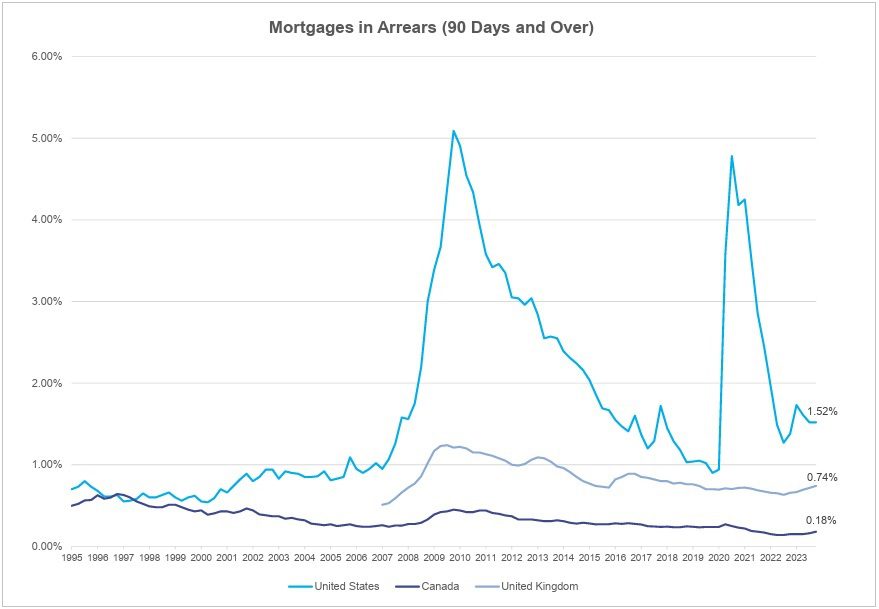
“Gather round, youngsters. Let me tell you about 2008…”
I think we all know that Canada escaped the financial crisis seventeen years ago essentially unharmed, but just look at the amount of mortgage delinquencies during the pandemic in the United Stats versus Canada.
Is there any conclusion to draw here other than the fact that Canada has among the lowest mortgage delinquency rates in the world?
The data I have for mortgage delinquencies only goes back to 2013 as that’s all that the CMHC makes publicly available (and I suppose easily accessible, so please email me if you have another source!).
But the Canadian Bankers Association article has data going bak to the 1990’s.
And while the following chart from the article is intended to plot unemployment against mortgage arrears, I want to draw your attention to the expanded data on mortgages in arrears:
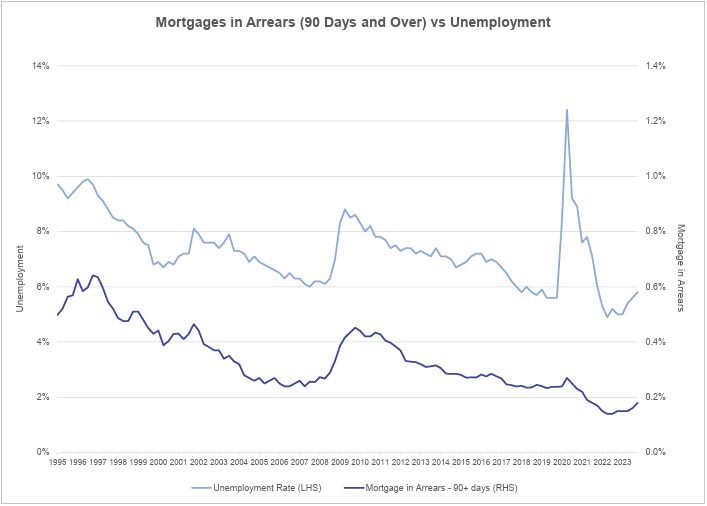
In my chart above, I showed you 2013 to 2025, and the conclusion you’re supposed to draw is, “Yes, the rate has increased, but it’s still low compared to 2013 – 2016.”
Showing you this chart now, your conclusion should be, “Mortgage in arrears have really never been lower than the past five years.”
It’s all relative.
It’s all perspective.
And if I could conclude with an annoying catch phrase that hit its peak of overuse around 2003, “It’s all good.”
I expect to see more articles about mortgage delinquencies, mortgages in arrears, and mortgage defaults in the coming months, but I’m going to conclude that it’s much ado about nothing.
Disagree if you choose, but there’s no denying the data above.

